

Beethoven's groundbreaking Symphony No. 3, 'Eroica,' headlines broadcast special
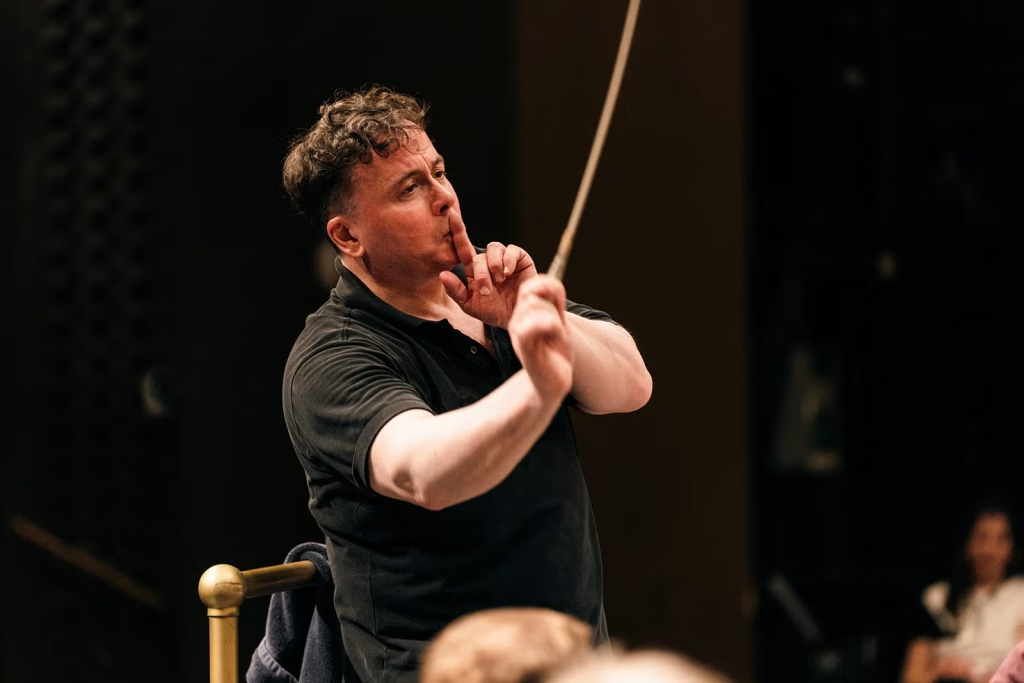
Members of the La Crosse Symphony Orchestra broke new ground when they took their seats for rehearsal on Nov. 12, 2025. Musical Director Alexander Platt had already spent years contemplating every detail about the work they would perform together in just four days, Symphony No. 3 in E-flat, Op. 55 “Eroica.”
Platt has been with the orchestra for 16 years but said that is the first time they had performed Beethoven’s pivotal third symphony. He said it took him a long time to be ready to bring this work to the LSO.
“I have to admit I’ve struggled with this piece as a conductor over many, many years in this conducting game,” Platt said. “In a certain way, Beethoven is very simple. It’s not like conducting Stravinsky’s ‘The Rite of Spring,‘ but interpretively, it is profoundly difficult. I felt like, for the first time, I finally made my peace with the piece.”
On April 8 and 12, WPR Music will premiere the 2025 performance. Platt spoke with WPR’s Ezra Wall.
The following interview has been edited for brevity and clarity.
Ezra Wall: What made you want to bring that work to La Crosse?
Alexander Platt: It was our November concert, which is always on or near our celebration of Veterans Day. We’ve developed a broadly American theme for this concert over the last 15 years. Obviously, Ludwig van Beethoven was a German-Austrian composer, but his third symphony has taken on profound overtones regarding human freedom and the quest for justice and democracy in the 200-odd years since it was written. It has an amazing, fascinating history that fit perfectly.
EW: People often hear about Beethoven’s evolution from his early music, rooted in traditional Classicism, to his later music, which was firmly part of the Romanticism sweeping Europe. Where does the third symphony fall on that spectrum?
AP: You could say the Romantic era literally begins with those opening cracks — those E-flat major chords. Beethoven is the composer who strides over both the Classical and Romantic eras.
His first two symphonies almost could have been written by his immediate predecessors, Haydn and Mozart. The First Symphony sounds like a very late symphony of Haydn, had he lived a few years longer. The Second could have been a late Mozart work. But the Third is something entirely new.
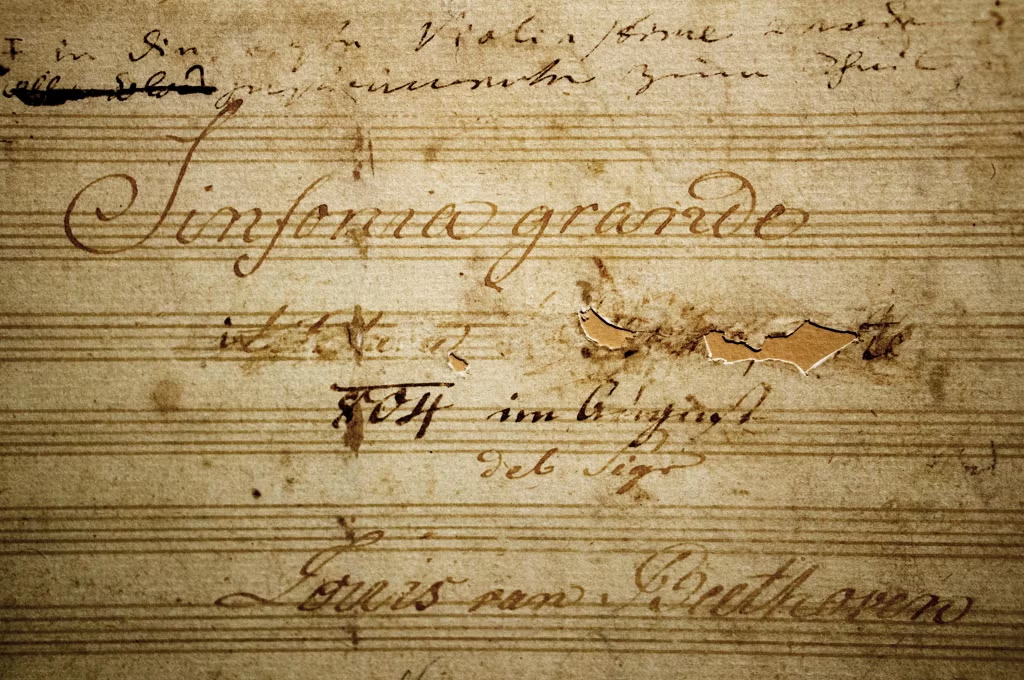
EW: There’s a famous story about the original dedication to Napoleon and Beethoven angrily scratching it out.
AP: Beethoven grew up in Bonn, right next to France, and became infatuated with the ideals of the French Revolution. When he moved to Vienna, he watched Napoleon Bonaparte, who first declared himself the First Consul of a Republic. Beethoven was enamored with the idea of Napoleon wiping the slate clean of decadent monarchism.
However, when Napoleon crowned himself Emperor, Beethoven was absolutely crushed. He scratched out the dedication so violently he broke the paper, eventually dedicating it to Prince Lobkowitz. Ultimately, as Beethoven wrote, the symphony was dedicated “to the memory of a great man.” It’s dedicated to the ideal of freedom and justice, not any one man. That is actually very liberating; it allows the listener to engage on a spiritual level rather than treating it as a literal description of a person. That puts the “Eroica” on a cosmic plane.
EW: I don’t think people realize how little time professionals get to prepare. Talk about the process. From the first rehearsal to the Saturday performance, how much time do you actually spend together?
AP: We have three evenings of rehearsal together. Since I arrived, we rehearse in the “European manner,” with three-hour sessions. It is very, very intense.
Once the clock starts at 7 p.m. for that first rehearsal, it’s three intense nights. I waited 15 years to do the “Eroica” with this orchestra. It’s a piece most conductors would have done in their first few years, but I waited because it is so incredibly hard to get right.
Listen to the La Crosse Symphony Orchestra’s performance of Symphony No. 3 in E-flat, Op. 55 ‘Eroica’ by Ludwig van Beethoven at 8 p.m. Wednesday, April 8 and at 2 p.m. Sunday, April 12.
Wisconsin Public Radio, © Copyright 2026, Board of Regents of the University of Wisconsin System and Wisconsin Educational Communications Board.